HEXASMAL: La Poste's official postal-code database
HEXASMAL is the file published by La Poste that lists all French postal codes. It is freely available and serves as the reference for all postal and logistics services in France.
What does the file contain?
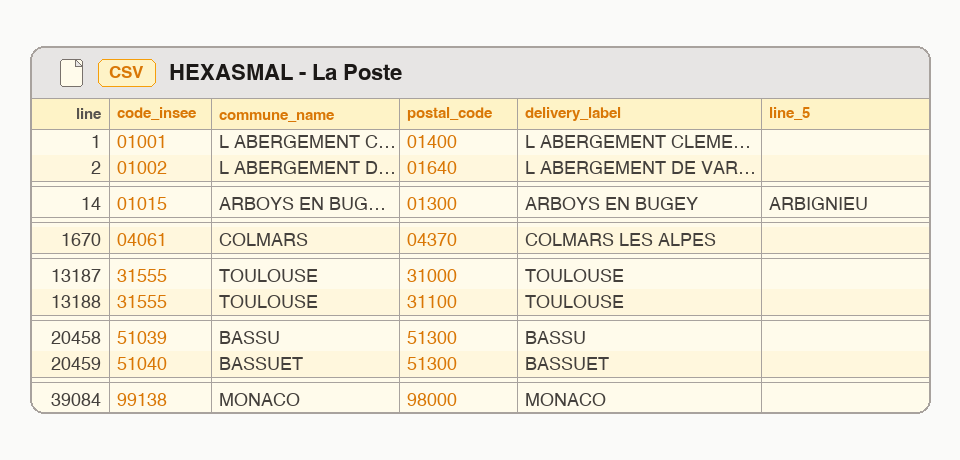
The current version has 39 084 rows, covering 35 007 communes and 6 328 distinct postal codes. Each row represents a link between a commune and a postal code. There can be multiple rows with the same commune when it has several postal codes, and conversely multiple rows with the same postal code when it covers several communes.
The columns
Each row of the file has five main fields:
code_insee— the commune's INSEE code (5 characters, e.g. 13004 for Arles).nom_commune— the official INSEE commune name, in uppercase (e.g. ARLES).code_postal— the 5-digit postal code (e.g. 13129).libelle_acheminement— In 99,5 % of cases, it equals nom_commune. In 0,5 % of cases, La Poste prefers to use a different name for the commune, to be written on the envelope (details below).ligne_5— optional sub-locality (hamlet, village, former commune…)
Example — the seven rows for the commune of Arles (INSEE 13004):
| nom_commune | code_postal | libelle_acheminement | ligne_5 |
|---|---|---|---|
| ARLES | 13104 | ARLES | MAS THIBERT |
| ARLES | 13123 | ARLES | L ALBARON |
| ARLES | 13129 | ARLES | SALIN DE GIRAUD |
| ARLES | 13200 | ARLES | (vide) |
| ARLES | 13200 | ARLES | LE SAMBUC |
| ARLES | 13280 | ARLES | MOULES |
| ARLES | 13280 | ARLES | RAPHELE LES ARLES |
The delivery label, sometimes different from the INSEE name
For 186 communes, the delivery label is different from the commune name. La Poste added this data for certain cases where there was a risk of confusion, especially for communes with short names.
A few examples:
| INSEE name | La Poste label |
|---|---|
| SEYNE | SEYNE LES ALPES |
| COLMARS | COLMARS LES ALPES |
| FLEURY | FLEURY D AUDE |
| ST FIRMIN | ST FIRMIN EN VALGODEMARD |
| CALLAC | CALLAC DE BRETAGNE |
| MONCONTOUR | MONCONTOUR DE BRETAGNE |
La Poste prefers that we use this label rather than the name of the commune
Why is everything in uppercase?
Every commune name and every label is stored in unaccented ASCII uppercase in HEXASMAL — you'll see ARLES not Arles, NIMES not Nîmes, ST DENIS not Saint-Denis. This isn't a formatting quirk: it's La Poste's addressing standard.
When writing a French address, the last line (postal code + city) must be in uppercase letters, without accents, without punctuation, left-aligned. That's the convention sorting machines are trained to read.
Line 5: sub-localities
The ligne_5 field holds the name of a sub-locality inside the commune: a hamlet, a village, or a former merged commune. Out of the 39 084 rows in the file, 4 696 have one (about 12%), for 4 548 distinct sub-localities.
Take Arles, metropolitan France's largest commune: its territory is so big that La Poste split it into five postal codes, some grouping several sub-localities. This lets a letter go straight to the right sorting centre without passing through Arles's main office first.
How do you write a French address?
A standard French address has at most six lines; the fifth is precisely ligne_5 when the destination is a sub-locality:
Madame Jeanne DUPONT          ← recipient's name
Résidence Les Mimosas         ← address complement (building, residence, …) (optional)
Bâtiment B                    ← address complement (entrance, PO box, …) (optional)
12 rue des Salins             ← street number and name
SALIN DE GIRAUD               ← line 5: sub-locality (optional)
13129 ARLES                   ← postal code + La Poste label
Line 5 is optional: only use it for communes that have declared sub-localities in HEXASMAL. Without it, mail would go through the main sorting centre first (Arles here) before being routed back to Salin-de-Giraud — adding one or two days to delivery.
Where to download the file
HEXASMAL is published as open data, updated regularly by La Poste.
view on data.gouv.fr ↗
view on laposte.fr ↗